

Free shipping on every order 🎉
Shall we fill it with something?
Free shipping on every order 🎉
Shall we fill it with something?
 Vinsmoke "Black Leg' Sanji…
Zoro’s cosplay changes by arc: pre-timeskip wears an open green haramaki with dark trousers and a bicep bandana, post-timeskip adds a green traveling robe, white trousers, the black sword Enma, and an eye scar, and Wano swaps to an asymmetric green kimono with hakama pants. All three eras keep the three-sword santoryu style, bandana, and gold earring constant, and a full build ranges from about $50 for a casual version to $250+ for a detailed, screen-accurate one.
Ask any con photographer to name the easiest silhouette to spot across a crowded floor and “green hair, three swords” comes up almost every time. Roronoa Zoro has been one of the most cosplayed One Piece characters for two decades running, and it’s not hard to see why: the look is instantly readable from across a hall, it scales from a five-minute budget build to a full armory-grade rig, and it holds up across every major arc without ever losing that core “swordsman” silhouette.
That said, “just wear green and carry some swords” undersells it. Zoro’s outfit actually changes a lot from East Blue to Wano, and getting the right combination of haramaki, robe, bandana, and blades for the arc you’re building matters if you want the look to read correctly. This guide breaks his outfit down arc by arc, covers all three swords by name, walks through prop options that won’t get you turned away at convention security, and closes with a budget breakdown so you know what you’re actually signing up for at every price point.
Part of it is pure visual efficiency. Zoro doesn’t need a full crew, a devil fruit effect, or a giant prop ship behind him to be recognizable — green hair, a bandana, and three swords at the hip does 90% of the work on its own. Part of it is versatility: because the silhouette stays consistent across arcs (open top, sash, swords, bandana), cosplayers can build a “good enough” version fast and then upgrade piece by piece over multiple cons instead of needing everything perfect on day one. And part of it is just character loyalty — Zoro’s been a fan favorite since the first arc, so there’s no shortage of reference art for whichever era you want to build.
Zoro’s core formula never really changes — haramaki or robe, bandana, three swords, gold earring — but the details shift enough between eras that mixing pieces from different arcs will read as “off” to anyone who knows the source. Here’s what belongs to each era.
This is the East Blue-through-Marineford Zoro most casual fans picture first, and it’s also the easiest version to build since it has the fewest layers.
Two years training under Mihawk changed more than Zoro’s skill level — the wardrobe grew up too. This is the look most cosplayers reach for when they want something a little more dramatic than the haramaki era without jumping all the way to Wano.
Wano gives Zoro his most visually distinct outfit in the entire series, and it’s the pick for cosplayers who want their build to stand out in a sea of pre-timeskip Zoros.
Santoryu — Zoro’s three-sword style — is non-negotiable for a convincing cosplay, and each blade has its own look worth getting right instead of grabbing three identical props.
Wado Ichimonji is the white-hilted blade Zoro’s carried since episode one — a promise kept to his late friend Kuina, and the sword he traditionally holds in his mouth for a santoryu stance. Look for a white or cream handle wrap and a plain, unadorned sheath.
Sandai Kitetsu is the “cursed” blade with a distinctive black-and-orange zigzag pattern down the blade itself, a design detail that’s a dead giveaway for anyone who knows the series — skip a plain silver prop here if you can.
Enma is the black-bladed sword gifted by Mihawk, easily the most dramatic of the three visually, with a dark hilt and sheath to match the near-black blade. It only enters the outfit at post-timeskip and later, so leave it out of a pre-timeskip build.
Three swords is already a lot of prop to carry through a con floor, and one of them is meant to be gripped in your teeth — so material choice matters more here than in most cosplays. Lightweight EVA foam or soft resin sabers are the standard choice for all three blades, especially Wado Ichimonji if you’re doing the mouth-hold; anything heavier is genuinely uncomfortable and unsafe to hold that way for a photo set. Hard plastic or display-grade metal-look props can work for the two hip-mounted swords if you want sharper detail for photos, but check the specific con’s weapons policy first — some cap prop length or restrict metal-look finishes even on blunt pieces.
Whatever material you go with, expect to get every blade peace bonded — tagged or zip-tied at the con’s weapons check-in table — before you’re allowed on the floor with three swords visible at once. The same general prop rules that apply to kunai and other convention props apply here: no functional edge, no sharpened points, and always check your specific event’s policy before you pack your sword harness.
Zoro’s hair is short and spiky enough that both routes work, but they solve different problems. A wig built for a short, textured style holds its shape all day, survives sweat and humidity on a packed con floor, and photographs consistently from the first panel to the last hour of the day — worth the extra cost if you’re wearing the cosplay for a full convention. Temporary green hair spray or chalk is the budget move: cheap, works on your real hair if it’s already short, and fine for a single photoshoot or a quick con appearance, but it fades, transfers onto light-colored clothing, and doesn’t hold up well through a hot, crowded exhibit hall. If you’ve got short hair already and only need one solid day, spray is a fair trade-off; if you’re doing multiple appearances or a photo-focused shoot, budget for a wig.
Zoro scales better than almost any other One Piece cosplay when it comes to budget — here’s roughly what each tier gets you.
| Tier | Price | What’s Included |
|---|---|---|
| Casual | ~$50 | Green hoodie or tee as a stand-in top, black bandana, hair spray, one budget prop sword, gold hoop earring — good for a quick meetup or a first attempt |
| Mid | ~$120 | Proper haramaki or robe, two to three foam prop swords, a short green wig, bandana, and a real gold-tone earring — the sweet spot for most first-time full builds |
| Full | $250+ | Tailored kimono or robe for your chosen arc, three detailed prop swords (including a screen-accurate Sandai Kitetsu pattern and black Enma), styled short wig, eye scar makeup for post-timeskip, and matched sash/boots |
If you’d rather display Zoro’s swords than wear them, our mini katana guide covers sizing and display tips for building a desk-shelf version of his three-sword set.
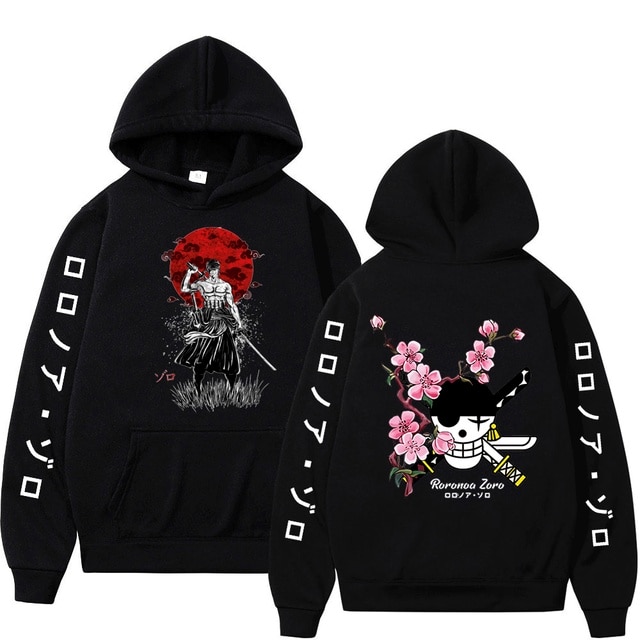
You don’t have to build the whole outfit from scratch to get some genuine Zoro energy into your everyday wardrobe. Our One Piece Roronoa Zoro Hoodie is a solid year-round pick — comfortable enough to wear to the con and back, and casual enough to wear on days you’re just repping the crew instead of cosplaying. If you want an accessory with a little more lore behind it, our Mihawk Sword Cross Necklace is technically Zoro’s rival’s blade rather than his own — but for any Zoro fan chasing “world’s greatest swordsman” energy, wearing a piece tied to the man he’s still training to surpass hits different.
Browse the rest of our One Piece character merch for more crew gear while you build out your cosplay closet.
More swords, more arcs, more nakama — believe it.
It depends on the arc. Pre-timeskip Zoro wears an open green haramaki with dark trousers, a black bandana on his bicep, and three swords at his hip. Post-timeskip he switches to a green traveling robe over white trousers, adds Enma as his third sword, and gains a scar over his left eye. In Wano he wears an asymmetric green kimono with hakama pants and a wide obi sash. All three eras keep the bandana, gold earring, and three-sword santoryu style constant.
Use lightweight EVA foam or soft resin prop swords, especially for Wado Ichimonji if you’re doing the mouth-hold santoryu pose, since anything heavier is unsafe and uncomfortable to grip that way. Get all three blades peace bonded (tagged or zip-tied) at the convention’s weapons check-in before heading onto the floor, and check the specific event’s prop policy in advance since rules on length and material vary by con.
Zoro’s hair is green, styled short and spiky in most official art and the anime. For cosplay, a short-cut green wig gives the most consistent color and hold through a full con day, while temporary green hair spray or chalk is a cheaper option that works well for a single photoshoot but fades and can transfer onto clothing.
A casual build runs around $50 using a green hoodie or tee as a stand-in top, a bandana, hair spray, and one budget prop sword. A mid-tier build (~$120) adds a proper haramaki or robe, two to three foam prop swords, and a short green wig. A full, detailed build with a tailored kimono or robe, three screen-accurate prop swords, a styled wig, and scar makeup typically runs $250 or more.